

Staying Motivated
A few steps to keep moving creatively

This is kind of an overflow post from “The Stay-at-Home Creative.” In the comments, Martha Nichols (mentor/boss/TW publisher) asked a question and suggested that I make a post out of my response. I’m doing this because of that suggestion, but also to expand on my answer because my thoughts swirled beyond the space that seemed appropriate for a comments section.
Her question was: “Where do you think your motivation to keep making music comes from?” and the first part of my answer was that it’s always been there. But I started to think about that too much and it seemed like there’s more to it.
While it’s true that my motivation to make music is always pressing at the back of my psyche, the more I think about it, the more I realize that it hasn’t always been there; it’s developed over my adulthood and stems from the first times I started to actually write music.
Growing up I always enjoyed music, and if given the choice between socializing and playing music, I’d opt for playing music. But I didn’t really become obsessed with music until I started writing my own in college and my young adulthood. That obsession has grown and become more consuming as I’ve continued to practice. It’s also been accompanied with a big “Why not?”
We’re kind of socially programmed to adopt the approach of, “I’m going to do this, and if it doesn’t work out then I’ll give up and get a real job.” But that approach has always seemed super weird to me, like, “I’ve been doing this alongside working this whole time, why would I give it up just because it hasn’t blown up?” The vast majority of working artists have other forms of income.
For me, even if I’m only doing it for a little bit each week or each day, I benefit from it, and the chipping away at it is still making slow progress. Over time that slow progress can produce something final.
I can’t instill you with the fire in the belly to make art that’s my baseline obsession, but sometimes getting started can be the biggest hurdle, especially if I’m setting a new routine or have been out of practice. Once I get going, though, I have way more trouble stopping and getting motivated to focus on my life responsibilities.
If you’re having trouble getting over the hump to integrate practice into your life, here are a few steps that came out in my comment:
Make it an actual priority by considering it important. This is can be really tough with no external validation, and I don't know that I have a great answer for convincing people of this, but I've become increasingly convinced of the importance of creative expression/play in everyone’s lives.
Put it into the routine. Just like exercising or anything else that you want to “get to”, just dedicating some time to it, however small, will make a big difference in your relationship to it.
Consciously stifle the fear and doubt. I don’t think that anybody at any level is free of this blockage, and to me it’s almost more of a zen-like thing of having the fear and doubt present, but just consciously pushing it down or to the side and letting myself sit down with the instruments or computer.
One last thought about validation. I’ve always felt a little weird about how we receive encouragement and how that affects whether we continue doing something. I’ve had several experiences where it seems like people have a bigger reaction to some sort of external marker of validation like press coverage than they do to the art itself. It’s irked me and made me feel like there’s an implicit message of being more impressed with the tangible artifact of perceived popularity than with the work. It doesn’t actually change what I’ve already done. To me it’s safer to take an attitude of moving forward and let all the external validation or lack thereof happen around you. It’s delusional to think that none of this will affect your motivation, but as much as you can, try to push forward without it in your mind.
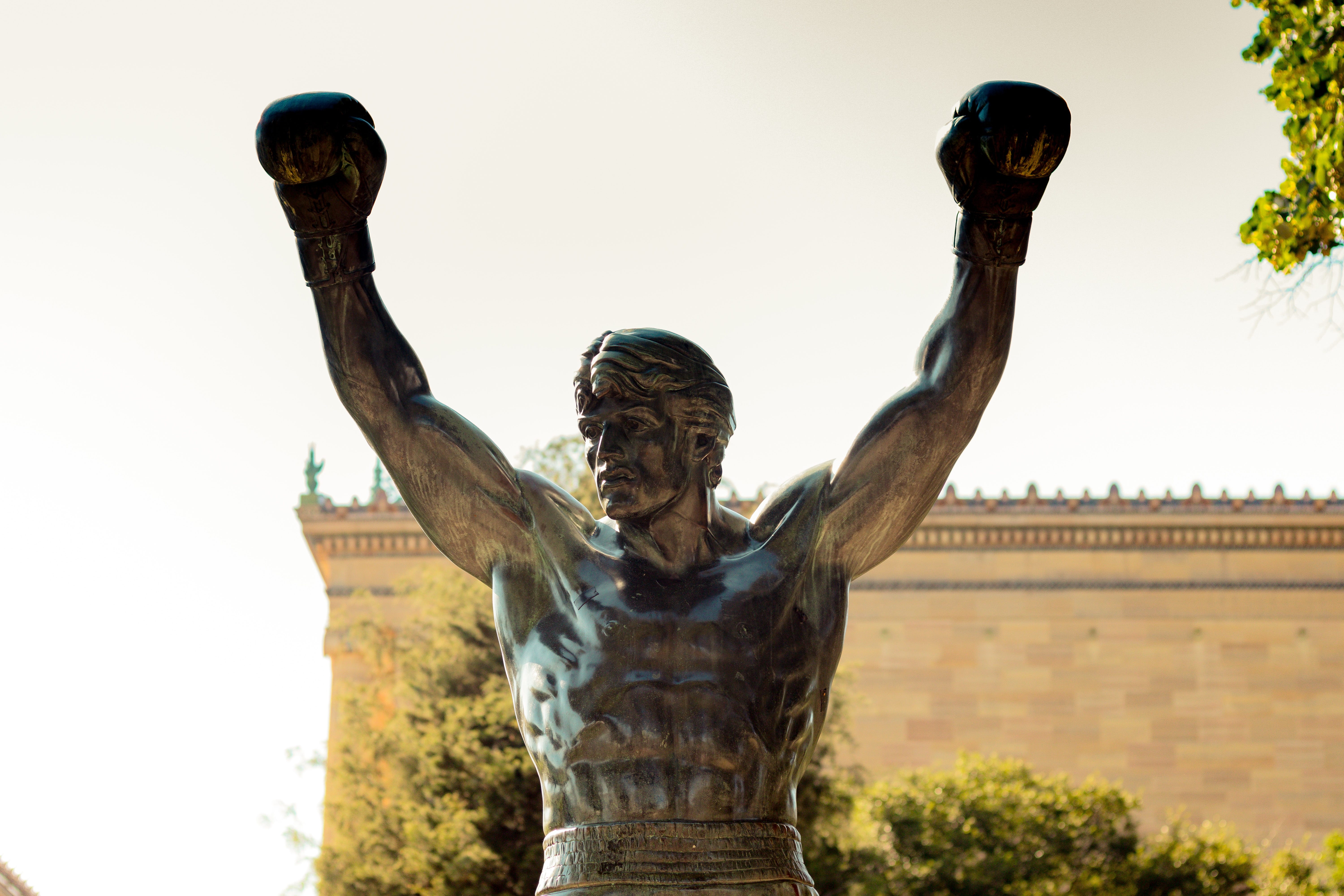
Photo of Rocky statue at the Philadelphia Museum of Art © Luisa Frassier; public domain.
"I’ve had several experiences where it seems like people have a bigger reaction to some sort of external marker of validation like press coverage than they do to the art itself. " I feel like this has the paradoxical effect of making it even more difficult to create authentic, meaningful art vs. art-for-business. In spite of others saying these two aren't mutually exclusive, in my experience, it's always been two completely different paths. More often than not, art without a business strategy will not hit "success" metrics like press coverage and popularity. I think it's important to insist on spaces (virtual or otherwise) where you can showcase and experience writing, music, and art that doesn't have strategy and marketing category in mind.